Social Media and Young Minds: Is it worth the risk?

Sofia Ghilardi Rosiles
Braeburn Arusha International School
Arusha, Tanzania
Social media is everywhere, it has become an essential part of modern life. Most people have heard of it, and many use it daily without fully understanding its origins or its potential consequences. Although these platforms are, in fact, tools for information, selling products, entertainment, and socializing, their impact, especially on young minds and brains, needs to be questioned. In this article, social media will be analyzed in an academic and semi-professional way. From the history behind the rise of social media and its purpose, to the effects of its use on the development of young minds and brains. Although social media has a lot of advantages and uses, absolutely everything has risks, no matter how good it may seem. But this raises the question: Is social media worth the risk in young minds?
What is social media?
In the words of Paljug, K. (2025), “Social media refers to online platforms where users can share information and connect with virtual communities through text, video, photos, and other content.“ Social media and youth mental health (n.d) adds that these platforms rely on content generated by their users, and on algorithms to guide user experience. On the other hand, non-social media includes static websites, traditional broadcast media like TV and radio, and private one-on-one texting services.
- Examples of social media: Instagram, TikTok, Twitter (X), Facebook, Snapchat.
- Examples of non-social media: WhatsApp, research websites, Tv programs, radio programs.
The History of Social Media
According to Britannica (n.d) there were two major companies in the 1990s developing social media, the first creating Classmates.com, founded in 1995 by Randy Conrads, a former Boeing engineer. It was thought of as a way to reconnect with old school friends. The problem with it is that it used an aggressive pop-up advertising campaign to draw web surfers to its site. The second one is SixDegrees.com, founded in 1997, and Britannica (n.d). This one is considered the actual first social networking site. This is because it had the characteristics that actually define social media. Unlike Classmates.com, SixDegrees.com members could create profiles of their own, have lists of friends, and contact other people
with a private messaging system.
Even though people had SixDegrees, this site eventually came to an end, but it did inspire a new way of communication. In the early 21st century, this new invention became popular, and networks such as Ortiz-Ospina, E. (2019) Friendster and MySpace were the closest thing to modern social media. They even were at the level of Facebook in 2008, but in 2012 their time came to an end. According to Britannica (n.d), after facebook a lot of new social media started to get launched, each with a specific use. Some of the best-known are TikTok for sharing short videos, YouTube for sharing videos, and Instagram for vlogging. Ortiz-Ospina, E. (2019) explains that over the years, social media became more popular, more common, and more used; One out of 3 people was using social media. They proportionate a graphic from 2004 to 2018, showing the number of users on each social media. And the numbers are alarming.
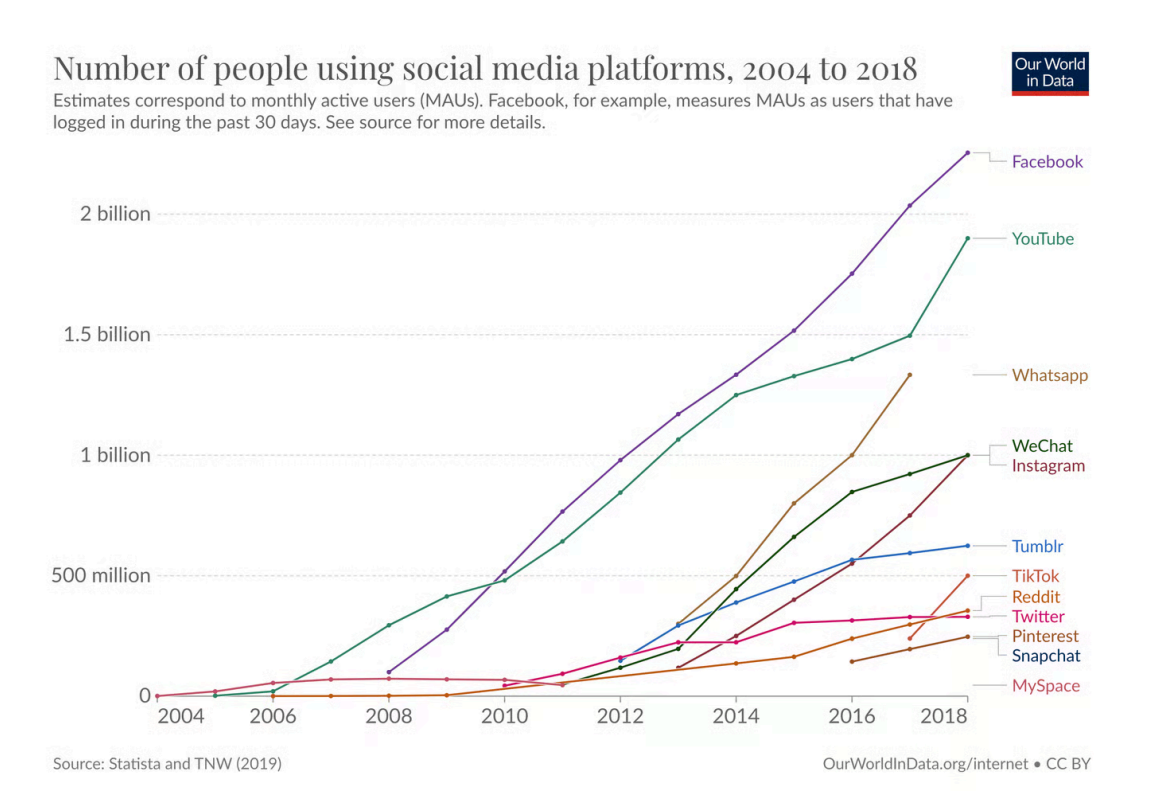
The chart was 8 years ago, and the fact that Facebook alone had 2 billion users is not only amazing, but it is also scary. It has to be considered that in 8 years, social media has become even more popular than it was before, which means that this number will now be even higher.
Who Uses Social Media?
Statista (2025) explains that social media is one of the most popular online activities. In 2024, over 5 billion people were using social media all around the world. And they estimate that this number will increase to 6 billion in 2026. But now, this generates a new question. Who are all those people?
To understand it better, it is necessary to know which generation represents each set of ages.
Frey, W. H. (2026): Baby Boomers: Born between 1946 and 1964 - 80 to 62 y/o
Britannica. (n.d): Gen X: Born between 1965 and 1980 - 61 to 46 y/o
BambooHR (n.d.): Gen Y (Millennials): Born between 1981 and 1996 - 45 to 30 y/o
Britannica. (n.d): Gen Z: Born between 1997 and 2012 - 29 to 14 y/o
McCrindle (2024): Gen Alpha: Born between 2010 and 2024 ( approximately) - 13 to 2 y/o
Now, who uses social media the most, well, according to Milan. (2024) about 80% of each generation (excluding Gen Alpha) use social media at least once a day, but Millennials and Gen Z use social media more times in a day. Another important point is that older generations use a bigger number of platforms, specifically around 5 or 6 platforms. On the other side, Gen Z prefers to use around 2 to 3 platforms. Now let’s focus on this specific data. Which are these 3 platforms that Gen Z prefers to use?
Gen Z on Social Media
According to Schaefer, A. (2026), Gen Z prefers to use Instagram with 89% Gen Z users, YouTube with 84% of Gen Z users, and TikTok with 82% of Gen Z users. But why this 3? Well Milan. (2024) had explained that Gen Z likes to be away from older generations, who are more likely to use other platforms; but also, they have specific uses for each platform, because of these they don't need to use different ones. Although 3 main characteristics that attract this generation more than others are their short-form, visual, and interactivity of the content.
All of this has pushed Gen Z to change these 3 platforms for everything else. Patel, F., & Patel, F. (2024) explain that nearly 40% of Gen Z prefer to use TikTok and Instagram to look for information, rather than other, more reliable sources like Google. All because it has become easier to learn from a short video than it is to read 5 pages of long and boring paragraphs. The format of TikToks, reels, and YouTube Shorts fits the requirements of this generation to learn, get inspired, and share content in the easiest and most fun way possible.
Social Media in The Eyes of Gen Z
From the personal point of view of a 17-year-old teen, I believe that by using these platforms young minds can become part of something, of a community. They are able to fit into a group of people who share their same interests, and at the same time they can also share about it. These platforms are a way of learning. Professional News has also moved to this platform to share information; activists are speaking up on this platform because they know it's easier for people to see what's happening in the world, and no media is changing the facts; it's just them and their voices speaking up.
The problem for me is that social media is also a competition of who has the most, who travels the most, who knows better, and much more. People show a fake lifestyle on these platforms that makes young minds stressed about what they are not. They try to reach unrealistic goals in money, body, and mind. These platforms are selling the lifestyle of a robot, and they are selling us products to achieve these goals. products that don't work, that we do not need, and that we don't want. But the platform makes us want them and makes us buy them.
Another major problem of this content format is how addictive it is, especially for minds that are dreaming, learning, and growing. In less than 5 minutes, you can watch a wide variety of content, and after an hour of scrolling, you did not do anything productive and got disappointed with yourself for procrastinating. But what most people don't realize is that these platforms are made for people to get addicted, to continue watching, to continue buying. The For You Page (FYP) adapts to what you enjoy watching and then continues giving you that type of content. After that, it is hard to stop but easy to continue.
And other users do not help either, there are too many people on these platforms, everyone with different thoughts, and people do not like differences, that is when the hate starts. People are behind a screen, they don't even have to show their face, so they are less afraid to speak, to hate, to bully; and this is a well-known problem between teens and preteens. Instead of bullying their classmate and having the risk of getting in trouble with a teacher, they bully their classmate online.
This lack of a face creates other problems, not only cyberbullying. It is called catfishing, and it can happen in many different ways. Someone who in person looks really different than online because they decided to use filters, or a grown adult who says to be a child online. This second one is known to be a serious problem, especially when it comes to younger children using this platform. These adults will communicate with children, stating that they are children too, but then they’ll manipulate these children to send or do stuff that children are not supposed to do. There are cases where they even arrange meetings with these children, and the situation is complicated even more. Campbell, F. M. P. C. &. C. (2024) gives the example of Alexander McCartney, a 26 year old that had over 3,500 online victims, from 10 to 16 years old. One of these victims was only 12 years old, her name was Cimarron Thomas, and she took her own life in 2018 while he was being abused.
With this, it is already clear that Gen Alpha is also starting to engage with social media. Instead of playing outside, with friends or imagining something incredible like most children in past generations. They are getting their entertainment fully or mostly from the digital world. Parents are using platforms like YouTube to distract their children and forget about them for a little while. There is even a new name for these kids that can’t be apart from their technology, iPad-Kids/Tablet-Kids. And parents don’t realize how harmful this can be, they may think that because it is not a phone it is okay. But even in some cases, these young kids already have phones.
It is also well known that digital creators like to publish younger kids, because it is interesting for people to see a kid doing something that they wouldn’t or didn’t do at their age. This creates curiosity, and it generates money. At the same time, these kids are also drawn to become influencers and achieve those impossible goals mentioned before. The problem is that these kids are more likely to be manipulated by social media and the catfishers mentioned before. But the most important fact is that their brains are more sensitive to the damage produced in social media, because their brains are in the middle of developing. Abrams, Z. (2022).
What does all of this show us? Social media is a tool; I won't say it is not, but with all of these risks, it is a fact that, in one way or another, it affects young minds.
How Does Social Media Affect Young Minds?
According to First, Y. (2019), preteens, teens, and now younger children too, may change their appearance, engage in negative behaviours, accept risky social media challenges, and other actions to gain attention and recognition in the form of likes, comments, and follower number. But the urge for this attention on social media has shown to be related to the increase of depression, anxiety, and low self-esteem.
Nowadays, these younger generations prefer to develop communication skills using these platforms, instead of practicing face-to-face conversations, which involve body language, facial expressions, and vocal inflections. Because of this, when they have to engage with someone in the real world, it is much harder for them to do so. Because of the addiction to these platforms, these generations end up lacking sleep and have poor academic performance.
Ehmke, R. (2026) defines in a more specific way 2 other main negative effects of social media on younger generations.:
1.Cyberbullying and impostor syndrome:
It is way easier to be cruel online because not only is it harder for this generation to interact in real life, but it is even harder to tell inappropriate or rude comments to other people. Social media is teaching children to disagree with others, to attack them, and dismiss them. Because women are pressured to meet all kinds of standards and more on social media. Because of this, it is more common for them to have low self-esteem, which is proven to push people to bully others, so that they can feel better about themselves. “Kids gang up on each other.” They are in the middle of finding their identity. They want to be part of a group, they want to be part of something, and most importantly, they want to be accepted. Social media makes this process much worse; people can say how much they like you with likes, and that is supposed to make them cooler.
2.Stalking and Imposter Syndrome (and being ignored):
When kids scroll and analyze each other's profiles, they are comparing themselves to others. This only makes them angry with others and with themselves, without realizing that it is only an online profile. These profiles sometimes don’t even represent what these kids are or like. With phones, no one is ever alone; they can be carried everywhere, which means that social media will be everywhere too. These younger generations are always updating something; their status, what they are watching, listening to, reading, everything, even their location in some cases. This creates a sense of hyperconnectivity with the children. This is certainly bad because it is a requirement for a healthy individual to have alone time to regroup, replenish, and chill out; people need intimacy. When someone doesn’t have that, it is easy for them to become emotionally drained, and it is easier for them to feel anxiety. It is also easier for these people to feel lonely, because they are always replying to each other; when someone does not reply, they feel depressed; they are not used to that. When you have a conversation that doesn’t end, the constant waiting gives anxiety.
Ehmke, R. (2026) gives the perfect example of a teen relationship: “In the old days, when a boy was going to break up with you, he had to have a conversation with you. Or at least he had to call. These days, he might just disappear from your screen, and you never get to have the ‘What did I do?’ conversation.” And this is completely true, it leaves these teens and kids thinking the worst about
themselves.
How Does Social Media Affect Young Brains?
It is already clear that social media is capable of negatively affecting young minds, but how does this relate to the brain's functioning? How is the brain capable of causing all of this?
And how does social media generate this reaction in the brain?
It was mentioned before that young brains are affected on a larger scale because they are in a state of development. This makes things much worse due to the fact that the brain is more sensitive. Fishman, L. (2025) talks about the study from JAMA, which explained that kids who regularly checked social media showed a different neurodevelopment trajectory in various regions of the brain.
They do state that it is still too early to fully say that social media is the only cause of these changes, but social media is likely related to these neurological problems.
During 3 years, the researchers analyzed the brain activity of teens who regularly checked social media, and compared the results with those of teens who didn’t.
Social media is affecting the brain in a very specific way; it’s affecting areas in the brain that are associated with social rewards and punishment. Not only does this affect the brain's correct development, but it also affects how teens interact with other people. But neither of these has been proven to be good or bad. According to the research made by Martins, D., Rademacher, L., Gabay, A., Taylor, R., Richey, J., Smith, D., Goerlich, K., Nawijn, L., Cremers, H., Wilson, R., Bhattacharyya, S., & Paloyelis, Y. (2021) this are the areas of the brain associated to social reward and punishment: basal ganglia, the midbrain, the dorsal anterior cingulate cortex, the supplementary motor area, the anterior insula, the occipital gyrus and other frontal, temporal, parietal and cerebellar regions not captured in previous coordinate-based meta-analysis. This means that these areas of the brain are the ones targeted by social media. And (19) gives the major areas affected.
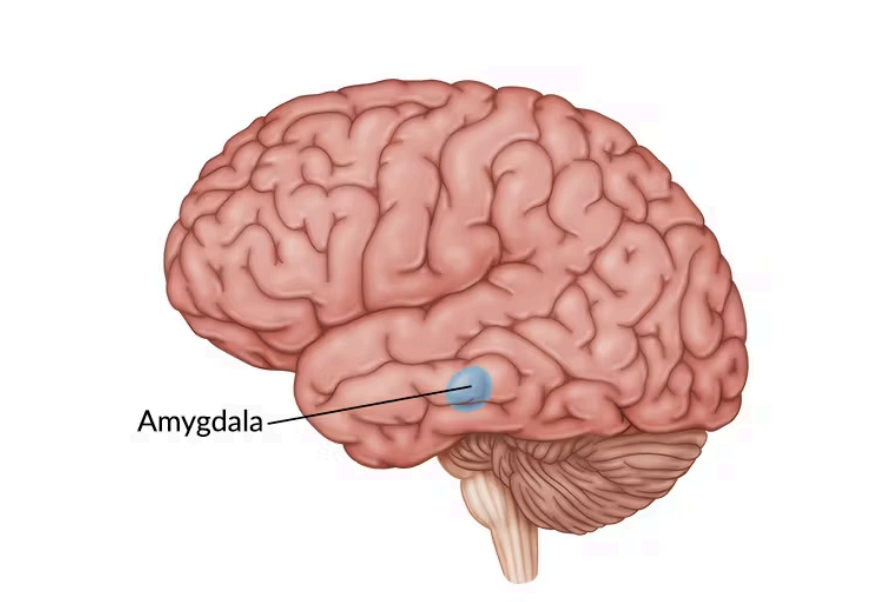
The amygdala (image 2) is one of the emotional centers of the brain, and in the study made by JAMA, it showed that it was one of the areas that were more affected. This area is in charge of making humans feel fear; it makes people react.
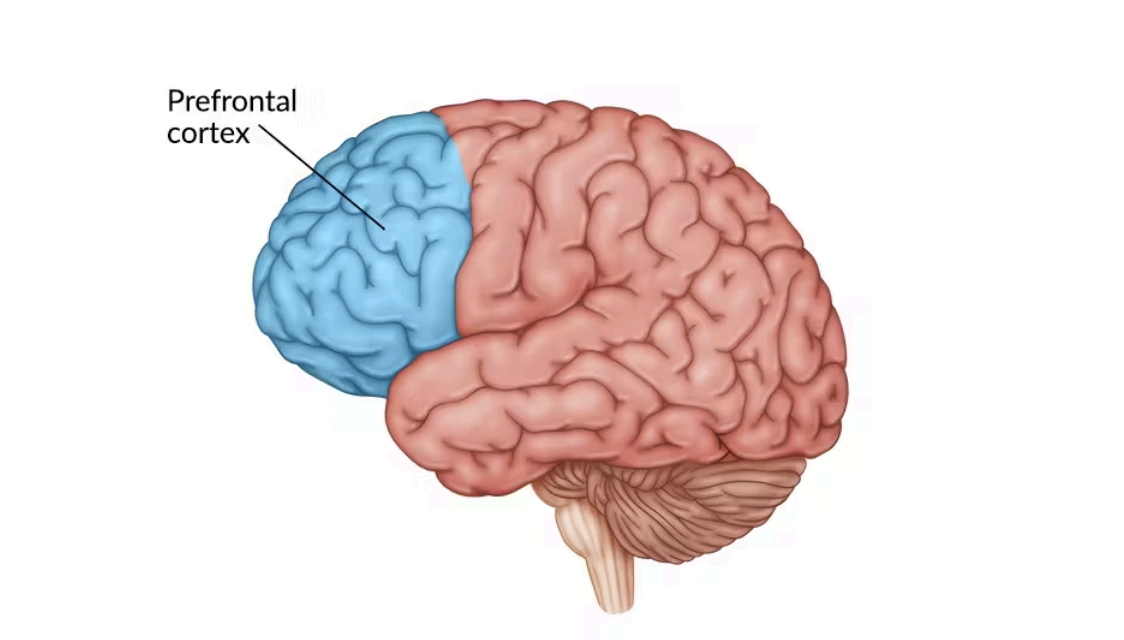
The prefrontal cortex (image 3) is responsible for judgment, reasoning, and reward; because of this, this area was also one of the major ones affected.
Other areas responsible for processing negative or positive emotions showed a lower sensitivity to social anticipation in the individuals who frequently checked social media. Long-term brain changes were also detected in these teens. One of the problems is that social media gives easy and quick dopamine, which means that the use of social media can develop into an addiction.
These changes are reversible in a way. This is explained with Neuroplasticity, which is when neurons are being pruned; this is to remove unnecessary neuronal structures from the brain, due to the fact that these neurons are not being used. After this, there is a gap where new connections of neurons are created to fill this space. These new connections are created through experiences.
In the case of teens and children, their brains are constantly and rapidly changing. This makes their brains more mouldable. This means that they will probably develop new neural connections in response to their experiences online.
The overall conclusion of the study is that the use of technology, and especially social media, is capable of reducing the integrity of the brain. They recommend that before the 18 and 24-month mark, there should be absolutely no screen time. And after that, it should be introduced into their lives gradually through the years.
They explain that “Preliminary studies show that these kids, who are now in fourth or fifth grade, have weaker academic skills than other fourth or fifth grade students in the past. This was also a critical time for social and emotional development, and kids missed out on things like squabbling over toys.”
Conclusion
Social media has grown rapidly since Facebook came out into the market. It started with the idea of a tool to reconnect people. Today, it is absolutely everywhere. It is used by almost everyone, no matter the generation. There is a wide variety of platforms to choose from, each with a specific purpose. These platforms are being used as online tools to socialize, sell, and buy products, and even get information. Because of this, they often replace other online tools.
However, it comes with a significant risk, especially for the younger users. Social media is capable of making an impact on the capability of younger generations to socialize outside of screens, it reduces their capability of empathy, and most importantly, it has a direct impact on brain development. This is particularly concerning, since children’s and teens’ brains are still developing, and because of this, they are even more sensitive.
For this reason, it is essential to use social media consciously and responsibly. Young users should avoid relying entirely or mostly on social media to perform actions that could be performed without the use of these platforms. By reducing the amount of time spent on these platforms, the negative effects on mental health and brain development can be reduced. Social media can be beneficial, but how people use it defines the negative or positive impact that they will have.
Bibliography
- Definition, History, Examples, & Facts. (n.d).
Britannica.https://www.britannica.com/topic/social-media - Classmates.com becomes probably the first For-Profit social networking site : History
of information. (n.d.). https://historyofinformation.com/detail.php?id=1084 - Ortiz-Ospina, E. (2019, September 18). The rise of social media. Our World in Data.
https://ourworldindata.org/rise-of-social-media#:~:text=Endnotes,and connect%2
0with%20other%20users - Topic: Social media. (2025, December 17). Statista.
https://www.statista.com/topics/1164/social-networks/ - Frey, W. H. (2026, January 7). Baby boomers are turning 80. Brookings.
https://www.brookings.edu/articles/baby-boomers-are-turning-80/#:~:text=Me - Generation Y. (n.d.). bambooHR.
https://www.bamboohr.com/resources/hr-glossary/generation-y - Gen Z Years, Age Range, Meaning, & Characteristics. (n.d.). Britannica.
https://www.britannica.com/topic/Generation-Z - Generation X Origin, Years, Characteristics, & Facts (n.d.). Britannica.
https://www.britannica.com/topic/Generation-X - McCrindle. (2024, April 4). Understanding Generation Alpha - McCrindle. McCrindle.
https://mccrindle.com.au/article/topic/generation-alpha/generation-alpha-defined/#:~:t
ext=According%20to%20Mccrindle%2C%20Generation%20Alpha%20is%20the,long
er%20life%20span%20than%20any%20previous%20generation - Milan. (2024, May 27). How different generations use social media: boomers, Gen X,
millennials, Gen Z. InDigital | Inventivna Digitalna Agencija.
https://indigital.rs/en/how-different-generations-use-social-media-boomers-gen-x-mill
ennials-gen-z/#:~:text=More%20than%2080%25%20of%20every,to%20this%20new
%20social%20network - Schaefer, A. (2026, January 8). How Gen Z uses social media and what that means
for brands. Sprout Social.
https://sproutsocial.com/insights/gen-z-social-media/#:~:text=Which platforms%2
0does%20Gen%20Z,)%20and%20brand%2Dinfluencer%20collaborations - Patel, F., & Patel, F. (2024, October 14). Gen Z’s new search engine: TikTok and
Instagram are taking over Google. AMA Boston.
https://amaboston.org/gen-zs-new-search-engine-tiktok-and-instagram-are-taking-ov
er-google/#:~:text=A%20Shift%20Toward%20Visual%20Learning,without%20ever%2
0leaving%20the%20app
13. Campbell, F. M. P. C. &. C. (2024, October 25). Catfishing: Alexander McCartney
jailed for minimum of 20 years. https://www.bbc.com/news/articles/cj4d40922xvo
14. First, Y. (2019, January 28). Social media affects young minds.
https://youthfirstinc.org/social-media-affects-young-minds/#:~:text=Because of%2
0what%20is%20seen,and%20how%20they%20are%20used
15. Abrams, Z. (2022, February 3). Why young brains are especially vulnerable to social
media. American Psychological Association.
https://www.apa.org/news/apa/2022/social-media-children-teens#:~:text=Some re
asons%20why%20young%20brains%20may%20be,face%20a%20higher%20risk%2
0of%20online%20harassment
16. Paljug, K. (2025, October 20). Social media: definition, importance, top websites, and
apps. Investopedia. https://www.investopedia.com/terms/s/social-media.asp
17. Ehmke, R. (2026, January 16). How using social media affects teenagers. Child Mind
Institute. https://childmind.org/article/how-using-social-media-affects-teenagers/
18. Fishman, L. (2025, August 9). How social media use affects adolescent brain
development. NewYork-Presbyterian.
https://healthmatters.nyp.org/how-social-media-use-affects-adolescent-brain-develop
ment/#:~:text=Social%20media%20has%20revolutionized%20the,letting%20children
%20use%20social%20media
19. Martins, D., Rademacher, L., Gabay, A., Taylor, R., Richey, J., Smith, D., Goerlich, K.,
Nawijn, L., Cremers, H., Wilson, R., Bhattacharyya, S., & Paloyelis, Y. (2021).
Mapping social reward and punishment processing in the human brain: A
voxel-based meta-analysis of neuroimaging findings using the social incentive delay
task. Neuroscience & Biobehavioral Reviews, 122, 1–17.
https://doi.org/10.1016/j.neubiorev.2020.12.034
20. What is Social Media? (n.d.).
https://www.aap.org/en/patient-care/media-and-children/center-of-excellence-on-soci
al-media-and-youth-mental-health/qa-portal/qa-portal-library/qa-portal-library-questio
ns/what-is-social-media/#:~:text=Answer:%20Great%20question!,and%20the%20abil
ity%20to%20livestream
Image Bibliography
Cover Image
Gregory, K., DO. (2024, October 27). The harms of social media for children and
teens. MI Blue Daily.
https://www.bcbsm.mibluedaily.com/stories/health-and-wellness/the-harms-of-social-media-f
or-children-and-teens
Image 1.
Ortiz-Ospina, E. (2019, September 18). The rise of social media. Our World in Data.
https://ourworldindata.org/rise-of-social-media#:~:text=Endnotes,and connect with%
20other%20users
Image 2.
Otr/L, E. D. (2022, November 9). Damage to the amygdala: Understanding the
functions, symptoms, & treatments. Flint Rehab.
https://www.flintrehab.com/damage-to-the-amygdala/
Image 3.
Otr/L, E. D. (2023, July 8). Prefrontal Cortex Damage: Understanding the Effects &
Methods for Recovery. Flint Rehab.
https://www.flintrehab.com/prefrontal-cortex-damage/?srsltid=AfmBOooc_bZhIWF5HXO55D